HOLK Connect
The Hardware That Connects the Network.
HOLK Connect is the device a printer owner would use to join the software platform. It is development hardware: a LILYGO T-Display-S3 with an ESP32-S3, a display, buttons and its own cryptographic identity.
A photograph of the physical prototype is not published. The bench tool that identifies the board also shows device identifiers, and those do not belong on a public page. The illustration here is ours. It is not a picture of the finished enclosure.
In development
The development hardware is a LILYGO T-Display-S3. Its controller is an ESP32-S3, and the firmware runs on that board. A bench tool has identified the board over USB. This is prototype engineering, not a shipping appliance.
In development
The board has a colour display and physical buttons so an owner can read a local status and confirm a step without opening a private console. A finished on-screen product interface is not claimed. Button behaviour is part of the firmware work.
Tested in the laboratory
On the bench, the board is reached over USB. The tool has read the hardware model and checked that the expected firmware and a device identity are present. The private identifiers from that tool are not published here.
In development
Each device is designed to hold its own Ed25519 identity. The private key stays on the device. The service stores only a hash of the device token. A short-lived, one-time pairing code binds the device to an owner. Registration alone does not make a printer available for work.
In development
The device calls out over HTTPS. The platform does not dial the printer and does not open a port into the owner's network. A missed heartbeat is treated as offline. An end-to-end Wi-Fi session from the physical board is still engineering work, and no uptime figure is published.
Partly tested
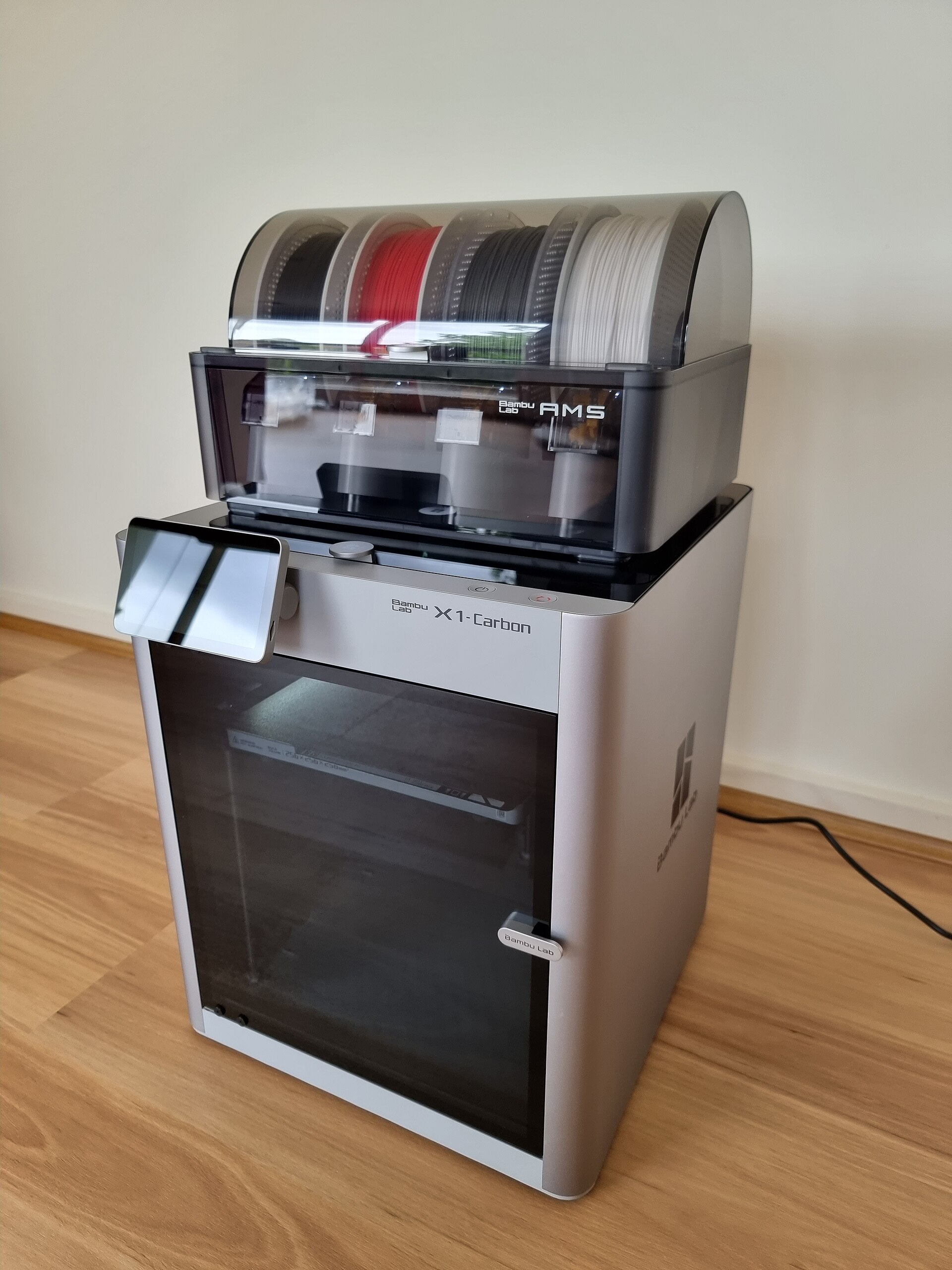
For the laboratory X1 Carbon, the production software has transferred a prepared file over the printer's local file channel and verified the checksum. The Connect check itself is specified as a read-only login to the printer's local message and file channels. It does not start a print. That check is not claimed as completed by the physical board.
In development
The status report can describe whether a printer is reachable and can carry filament-slot information. A stale report does not count as a live machine. Telemetry during a print has not been verified, because a print has not been started from the platform.
Planned
Support for more than one printer manufacturer is a development objective. The software has labels for additional Bambu Lab models and a generic filament category. Only the Bambu Lab X1 Carbon has been exercised against a physical machine. Universal compatibility is not claimed.
What the laboratory record supports
- The development board has been identified over USB, including the hardware model, firmware presence and a device identity.
- The Connect service implements pairing, a hashed device token, signed registration, heartbeats and a read-only printer check.
- The production software has transferred one prepared file to the laboratory X1 Carbon and verified the checksum.
What is not claimed
- A finished retail device, a public uptime figure or a photograph of the prototype.
- That the physical board has completed its Wi-Fi path.
- That the printer check has been completed by the physical board, or that a print has been started.
- Compatibility with every printer manufacturer. Further models are a development objective.