Manufacturing systems
In development
Connected Printer Network
Infrastructure that lets independently owned 3D printers participate in one production system without standing in the same factory.
What we are building
The software platform, the production record and HOLK Connect, as one path from a digital request to a specific machine.
The problem it addresses
A useful printer is often idle in a workshop, while a person who needs a part does not own a machine. Moving every job to one central factory throws away that distributed capacity.
How it works
A request becomes a job. The platform prepares the file. Production management keeps the state. HOLK Connect is the device that authenticates outward and talks to the printer on the local network. The tested instance of this path is a single laboratory printer.
Technical diagram
In development
A production request starts as a digital description of an object. In the laboratory, the software has accepted a test request and kept it as one job. That is an engineering test, not a published count of customers or commercial orders.
Partly tested
The platform holds the job, reads the model and prepares production data. Laboratory preparation uses OrcaSlicer for the Bambu Lab X1 Carbon profile under test. The platform is still being built. It is not a finished public production service.
Partly tested
A job moves through explicit states, including created, preparing, ready to start and transferred. Repeating the same request returns the same job. A person still authorizes sensitive steps. Automatic assignment across many printers is planned, not operational.
In development
HOLK Connect is the device that is meant to sit with the printer. It authenticates to the software and reaches the machine on the local network. The service does not open a route into the owner's network. The development board is a LILYGO T-Display-S3. It is not a finished retail product.
Partly tested
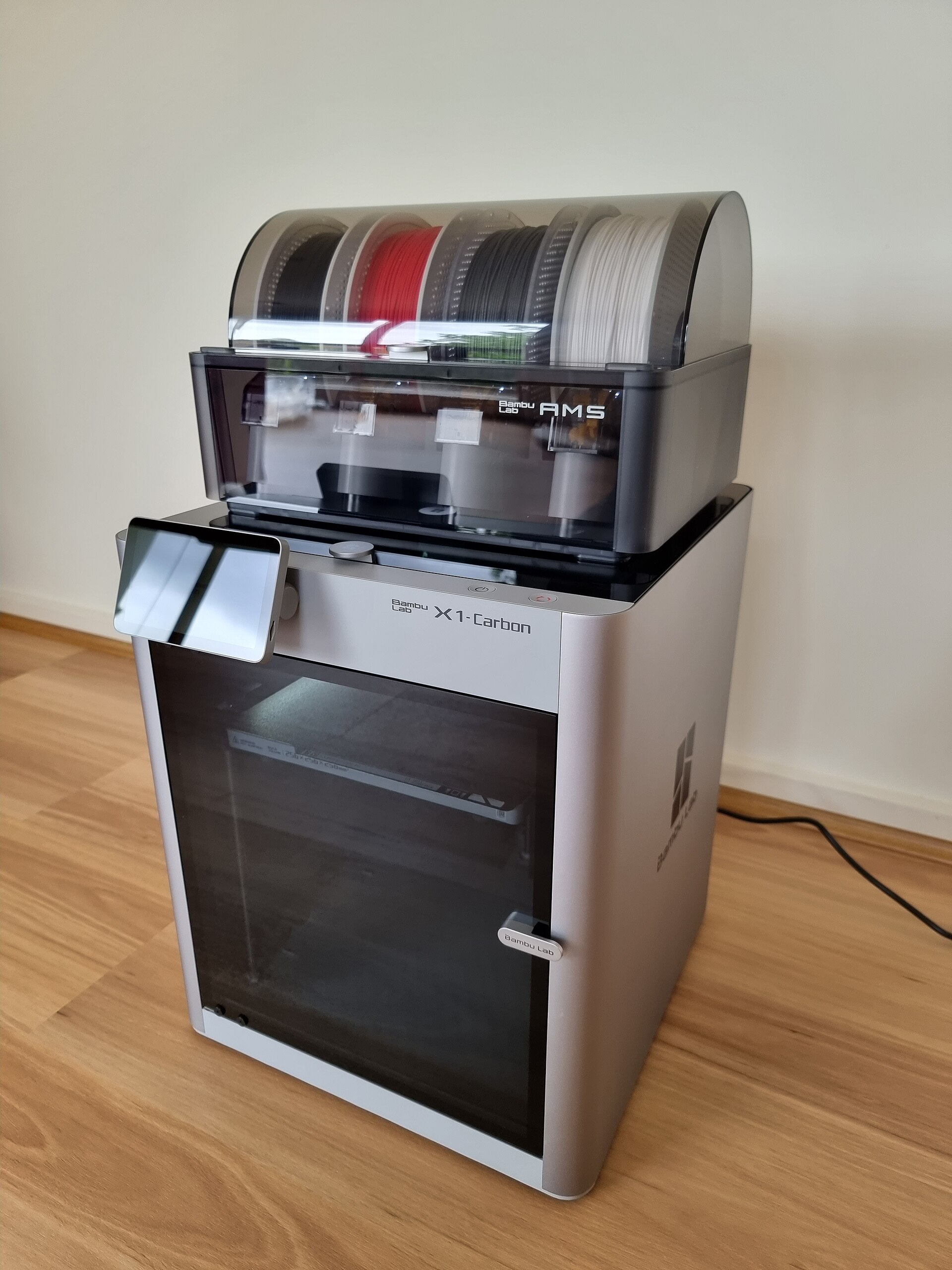
The tested machine is one Bambu Lab X1 Carbon in the laboratory. A prepared file has been transferred to it and checked by checksum. The print was not started. Further printers in this diagram are illustrative. They are not enrolled, and they do not represent an operating international network.
Technology being used
- Job records in the production software
- OrcaSlicer preparation for the laboratory profile
- HOLK Connect device identity and outbound HTTPS
- A local printer channel, exercised with a Bambu Lab X1 Carbon
Current development stage
The laboratory has created a test job, prepared a file and transferred it to one X1 Carbon, with a matching checksum. The print was not started. Illustrative locations on the map are not sites. An international network is the design goal, not a current operation.
Current milestones
- Keep the public description limited to one tested printer.
- Start a physical print only under a separate, explicit test decision.
- Add another machine only when that machine is actually enrolled.